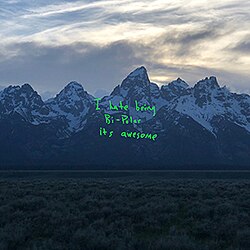
Recorded in days at a Wyoming ranch and clocking in at just seven tracks and 23 minutes, ye was an intimate and raw engagement with bipolar disorder, publicly disclosed for the first time on "Yikes". The album's cover — a mountain photograph with handwritten text — and its confessional directness stood in stark contrast to his previous maximalism. Despite its brevity it generated significant conversation about mental health and celebrity.
Deep Dive
Background
Kanye recorded ye in approximately two weeks at a ranch in Jackson Hole, Wyoming, gathering a small circle of collaborators in an atmosphere that was reported to be intensely concentrated and emotionally raw. The sessions followed a series of controversial public statements that had damaged his relationships and his standing, and the album was created partly as an act of explanation — or at least of honest self-presentation. At seven tracks and twenty-three minutes, it is the shortest album of his career, and its brevity feels calibrated: this is not a maximalist statement but a stripped moment of presence. The cover — a green mountain photograph with handwritten text — was taken by Kanye on the way to the listening party and chosen at the last minute.
Themes
ye is centrally about bipolar disorder — its title literally means 'you' in certain African languages, centering the listener — and the complicated experience of a condition that is simultaneously debilitating and, for some, a source of creative intensity. The album explores the edges between self-awareness and self-destruction, and what it costs to be honest about mental illness in public.
Production
The production is intimate and warm compared to the previous few albums — beat-driven but with a live, slightly rough quality that suits the confessional register. There is none of Yeezus's abrasion or MBDTF's orchestral grandeur; ye sounds like it was made by a small group of people in a room, because it was.
Legacy
ye generated more conversation about mental health in celebrity contexts than almost any album before it, and 'I hate being bipolar it's awesome' — scrawled on the cover — became one of the most discussed lines of his career. It is also the album that most directly prompted public engagement with the question of how we discuss mental illness in relation to artistic responsibility.
Best For
For anyone who has felt the disconnect between how they appear from the outside and what is actually happening inside — or who needs music that is honest without being performative about it.
Fun Fact
The cover photograph was shot through the windshield of a car on the drive from the Wyoming ranch to the listening party, and Kanye sent it to the designer as the album's artwork with only hours to spare before the event.
Tracklist — 7 songs
Producers — 1
Featured Artists — 2
Sample Map — 2 sources
Era — The Life & Gospel (2016–2019)
Spanning a turbulent personal and public arc, the Gospel-Life era opened with The Life of Pablo's chaotic fusion of gospel, trap, and EDM and closed with Jesus Is King's explicit Christian rap. The brief, confessional ye in between stands as the most personally vulnerable work of his career, grappling openly with bipolar disorder and fractured relationships. The era reflects an artist caught between competing impulses — ego and faith, spectacle and sincerity — that would define all subsequent work.
Also in this era